Honest budgeting
Excerpt: The real cost of Cyber Essentials certification - beyond the website price. What nobody tells you about the time, the stress, and the emergency biscuit runs.
Time, Stress, and Biscuits
An honest breakdown of what certification actually costs
The website said £300.
That's what I told my partner. "Three hundred quid and we're certified. Opens up government contracts. No brainer, really."
Six weeks later, I'd lost count of the late nights, nearly fallen out with Kev over password policies, and single-handedly kept the local shop in business through emergency Hobnob purchases.
The £300 was accurate. It was also about 10% of the real cost.
Here's what nobody tells you.
The Money (The Easy Bit)
Let's get this out of the way first. The actual certification costs vary by provider:
- Basic Cyber Essentials: £300-500 for the assessment
- Monthly support platforms: £20-50 per month
- Cyber Essentials Plus: £1,500-3,000 (if you need it)
That's the website price. That's what you budget for.
But money was the least of it.
The Time
This is where it gets real.
Week one: Understanding what we were actually being asked. Reading questions three times. Googling every other word. Realising how much we didn't know.
Hours spent: 8-10
Week two: Auditing our actual setup. Going through every laptop. Discovering horrors. Making lists of everything that needed fixing.
Hours spent: 12-15
Week three: Fixing things. Updates. Password changes. Configuration. Fighting with software that didn't want to cooperate.
Hours spent: 15-20
Week four: The wobble. Feeling overwhelmed. Wondering if we'd bitten off more than we could chew. Late night phone calls to support.
Hours spent: 10-12 (plus sleepless nights)
Week five: Getting into the rhythm. Answering questions with actual confidence. Seeing the finish line.
Hours spent: 10-12
Week six: Final checks. Submission. Waiting. Nail-biting.
Hours spent: 5 (plus constant email refreshing)
Total: 60-80 hours
That's not sixty hours of someone else's time you can pay for. That's your time. The business owner's time. Time you're not spending on customers, sales, or actually running the business.
We spread it across six weeks. Some businesses try to cram it into two. I don't recommend that unless you enjoy stress migraines.
The Stress
Nobody puts "stress" on an invoice. But it's real.
The fear of failure. What if we don't pass? What if we've wasted all this time and money? What if everyone finds out we don't know what we're doing?
The knowledge gaps. Every question you can't answer feels like proof you're not cut out for this. It isn't. But it feels that way at 11pm.
The team friction. People don't like change. When you tell Kev he can't use "Buster1962" anymore, he takes it personally. When you ask Sandra to document her backup process, she wonders if you don't trust her.
The responsibility. You're the one who said yes to this. If it goes wrong, it's on you. If the business loses time and money for nothing, that's your fault.
I won't pretend I handled all of this gracefully. There was a night in week four when I seriously considered giving up. Sitting at my desk at midnight, staring at a question about firewall configurations, wondering if I was an idiot for thinking we could do this.
Danny talked me off that ledge. Ironic, really - the teenager reassuring the business owner. But that's what it took.
The Learning Curve
This one's invisible but expensive.
Before certification, I didn't know what I didn't know. Afterwards, I knew quite a lot - but that knowledge came through hours of confusion, wrong turns, and starting again.
Things I had to learn from scratch:
- What a firewall actually does (not what I thought)
- The difference between anti-virus and anti-malware
- Why software updates matter so much
- How to write a password policy that people will actually follow
- What "access controls" means in practice
- How to document things we'd always done instinctively
Every one of those took time. Research. Trial and error. Sometimes Danny explaining things to me three different ways before it clicked.
That learning has value - I'm a different business owner now. But it wasn't free.
The Opportunity Cost
While I was doing Cyber Essentials, I wasn't doing other things.
Sales calls I didn't make. Clients I didn't follow up with. Quotes that went out late. A networking event I missed because I was too tired.
You can't measure this precisely. But it's real. Six weeks of divided attention has a cost, even if it doesn't show up in the accounts.
The Biscuits
I'm putting this in its own section because it matters.
Week one: Normal biscuit consumption. Digestives with tea, as God intended.
Week two: Slight increase. Stress eating begins.
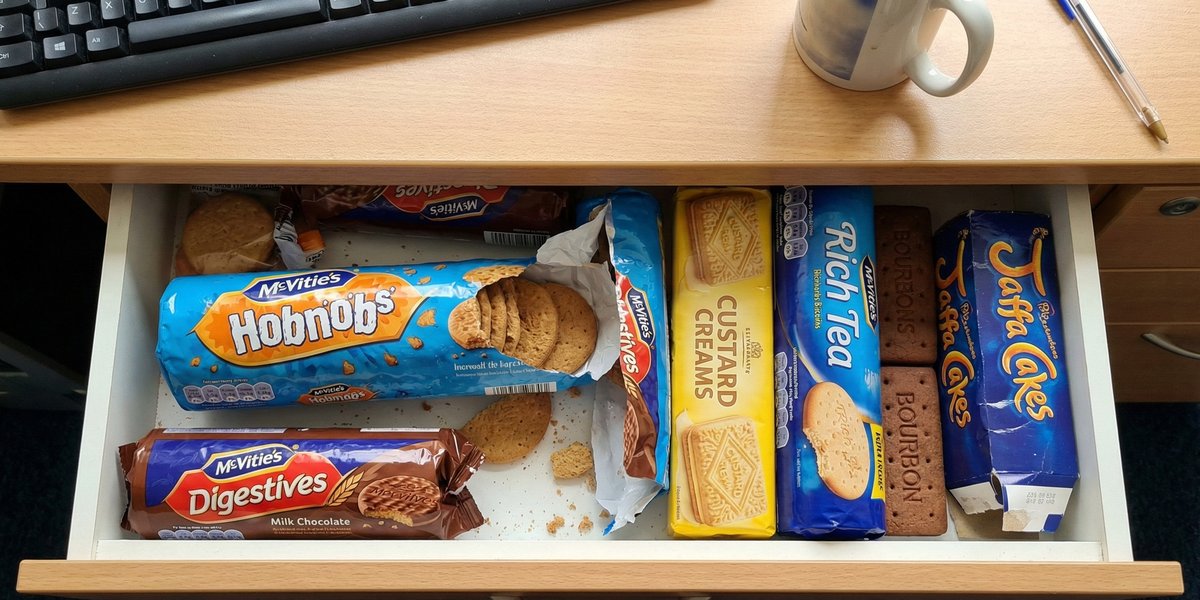
Week three: Kev's emergency biscuit drawer discovered and raided. He was not pleased.
Week four: Sandra starts bringing in "supplies." Family packs of Hobnobs. Chocolate digestives for "the really hard bits."
Week five: Danny develops a three-custard-cream-per-problem habit.
Week six: Celebratory biscuits. Fancy ones. M&S.
Estimated biscuit expenditure: £40-50
Laugh all you want. But when Danny and I were sitting at 9pm trying to understand access control policies, those Hobnobs were essential infrastructure.
The Hidden Costs Summary
| Cost | Website Price | Actual Impact |
|---|---|---|
| Certification fee | £300-500 | £300-500 |
| Your time | Not mentioned | 60-80 hours |
| Staff time | Not mentioned | 20-30 hours |
| Stress | Not mentioned | Significant |
| Learning curve | Not mentioned | Steep |
| Opportunity cost | Not mentioned | Real but unmeasurable |
| Biscuits | Not mentioned | £40-50 |
Was It Worth It?
Yes.
Without hesitation, yes.
The government contract we won has paid for the certification a hundred times over. The knowledge we gained has made us a better business. The processes we put in place have reduced our risk. The confidence we built has opened doors.
But I wish someone had told me the real cost upfront. Not to put me off - to prepare me. To let me know that feeling overwhelmed in week four is normal. That the time investment is significant. That Kev will sulk about his password for at least three days.
What I'd Do Differently
Block out proper time. Not "I'll fit it around everything else." Actual dedicated hours, protected in the diary.
Warn the team. Explain what's coming before you start. Get buy-in. Make it a team project, not a surprise imposition.
Stock up on biscuits. I'm serious. Small comforts matter when things get hard.
Ask for help earlier. I waited until week four to call support. Should have called in week one.
Celebrate small wins. Every completed section, every fixed vulnerability, every question answered. Mark the progress.
The Real Price Tag
Cyber Essentials costs £300-500.
Getting certified costs £300-500, plus sixty hours of your life, plus stress, plus learning, plus patience, plus probably some friction with your team, plus a small fortune in biscuits.
That's the real price tag.
It's worth paying. But you should know what you're buying.
Jim Simpson is an SME Cyber Resilience Consultant with TransCrypt. Kev has forgiven him for the password thing. The emergency biscuit drawer has been officially institutionalised and is now a line item in the office supplies budget.
Ready to streamline your compliance?
Join hundreds of fast-growing fintechs building with Transcrypt today.
Join the WaitlistAbout the Author
"We are building the operating system for compliance. Transcrypt removes the ambiguity from regulatory frameworks, turning them into deterministic, executable code."